

Grocery Price Index - Provincial Price Comparison - Essential Food Basket - Monthly Food Price Tracker
Retail vs. Wholesale Prices
CANADIAN GROCERY PRICES & FOOD AFFORDABILITY
Grocery Price Index • Provincial Price Comparison • Essential Food Basket • Monthly Food Price Tracker • Retail vs. Wholesale Prices
Understanding the Cost of Food in Canada
Canada Food Market Monitor tracks grocery prices and food affordability across Canada. We examine the cost of essential food products, compare average prices between provinces, monitor monthly price movements and examine the differences between retail and wholesale markets.
Our objective is to provide useful, transparent information for Canadian households, grocery retailers, food businesses, researchers and policymakers.
We look beyond the headline inflation rate to understand what Canadians are actually paying for food, how prices differ across regions and what market developments may be contributing to changes in food costs.
1. GROCERY PRICE INDEX
Tracking changes in Canadian grocery prices
The Grocery Price Index section monitors changes in the cost of food purchased by Canadian households.
We use Statistics Canada's Consumer Price Index (CPI) for food purchased from stores as the official measure of grocery price inflation.
Latest Canadian grocery inflation
Reference period: September 2026
-
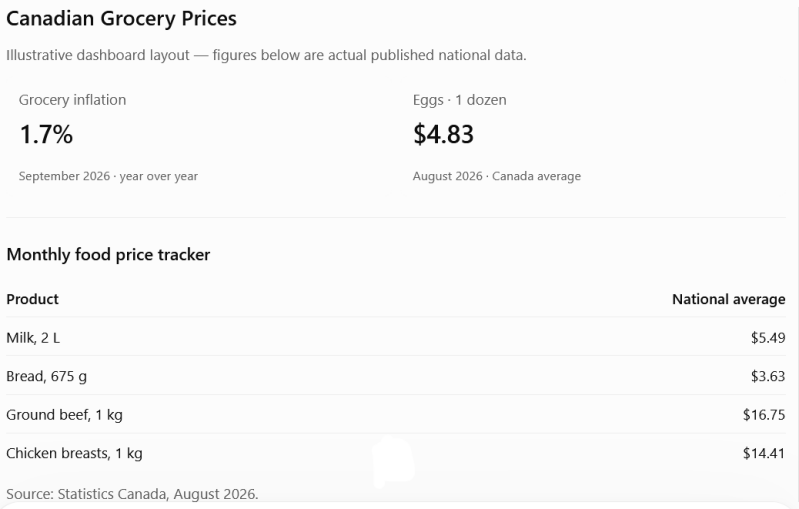
Grocery inflation: 1.7% year over year.
-
Previous month: 2.8% year over year in August 2026.
-
Cumulative increase: Grocery prices were 33.0% higher than in September 2020.
These figures show that the rate of grocery price increases has slowed, but the overall price level remains substantially higher than it was several years ago.
What we monitor
-
Monthly grocery inflation.
-
Year-over-year grocery price changes.
-
Food price movements by product category.
-
Historical grocery price trends.
-
Changes in the cost of essential food products.
-
Provincial and regional differences.
Why this matters
A decline in the inflation rate does not necessarily mean that grocery prices are falling. It means prices are increasing more slowly than before.
Understanding the difference between inflation and the actual price level is essential when assessing food affordability.
Official source: Statistics Canada, Consumer Price Index, Table 18-10-0004-01.
https://www150.statcan.gc.ca/t1/tbl1/en/tv.action?pid=1810000401
2. PROVINCIAL PRICE COMPARISON
How much does food cost across Canada?
Grocery prices can vary between provinces and communities due to transportation, distribution, competition, local supply, market conditions and differences in the products sold.
This section compares average retail prices for selected food products across Canada's provinces and territories.
Provinces and territories covered
-
Ontario
-
Quebec
-
British Columbia
-
Alberta
-
Manitoba
-
Saskatchewan
-
New Brunswick
-
Nova Scotia
-
Prince Edward Island
-
Newfoundland and Labrador
-
Yukon
-
Northwest Territories
Products to compare
-
Milk
-
Eggs
-
Bread
-
Butter
-
Cheese
-
Chicken
-
Ground beef
-
Rice
-
Apples
-
Bananas
-
Potatoes
-
Tomatoes
-
Cooking oil
Provincial comparison indicators
-
Average price by province.
-
Difference from the Canadian average.
-
Highest and lowest reported prices.
-
Monthly price changes.
-
Year-over-year price changes where comparable data is available.
Market interpretation
Provincial price comparisons can help identify where selected grocery products are more or less expensive.
However, differences in product quality, brand, package size, availability and purchasing patterns must be considered. A provincial average is not necessarily the price paid by every household or store.
Official source: Statistics Canada, Table 18-10-0245-01, Monthly average retail prices for selected products.
https://www150.statcan.gc.ca/t1/tbl1/en/tv.action?pid=1810024501
3. ESSENTIAL FOOD BASKET
What does it cost to buy essential groceries in Canada?
The Essential Food Basket is a proposed Canada Food Market Monitor indicator designed to track the cost of a consistent selection of everyday food products.
It will help households and policymakers understand how the cost of essential groceries changes over time.
Proposed food basket
Dairy and eggs
-
Milk
-
Butter
-
Cheese
-
Eggs
Grains and bakery
-
Bread
-
Rice
-
Flour
-
Pasta
Meat and protein
-
Chicken
-
Ground beef
-
Pork
-
Dry lentils and beans
Fruits
-
Apples
-
Bananas
-
Oranges
Vegetables
-
Potatoes
-
Tomatoes
-
Onions
-
Carrots
-
Seasonal vegetables
Cooking essentials
-
Vegetable oil
-
Sugar
How the basket will be measured
We will establish consistent product specifications, package sizes and quantities.
The basket will be calculated using published average retail prices and will be updated as new verified data becomes available.
The website will aim to show:
-
Total estimated basket cost.
-
Individual product prices.
-
Monthly change in basket cost.
-
Year-over-year change.
-
Provincial basket comparisons.
-
Changes in the cost of selected food categories.
Important: This is a proposed independent monitoring basket, not an official Statistics Canada food basket or an individualized nutritional recommendation. The quantities, specifications and calculation method will be published so visitors can understand and reproduce the calculation.
4. MONTHLY FOOD PRICE TRACKER
Following the prices Canadians pay
Our Monthly Food Price Tracker will monitor selected grocery products and identify changes in their average retail prices.
What the tracker will display
-
Latest published average price.
-
Previous month's average price.
-
Monthly dollar difference.
-
Monthly percentage change.
-
Previous year's comparable price.
-
Year-over-year percentage change.
-
Historical price movement.
Where data is unavailable, the tracker will display "Not available" rather than estimate a price.
Source: Statistics Canada, Table 18-10-0245-01, August 2026.
5. RETAIL VS. WHOLESALE PRICES
Understanding the difference between wholesale and supermarket prices
The price a retailer pays to purchase food is not necessarily the price a consumer pays at the supermarket.
Food moves through several stages, including production, processing, packaging, transportation, wholesale distribution and retail sales.
Each stage can involve additional costs and commercial margins.
Retail prices
Retail prices are the prices consumers pay when purchasing food from supermarkets, grocery stores and other retailers.
We monitor:
-
Average grocery prices.
-
Retail price movements.
-
Provincial price differences.
-
Food category inflation.
-
Consumer affordability.
Wholesale prices
Wholesale prices relate to the sale of food products in commercial quantities to retailers, restaurants, distributors and other businesses.
We monitor available information on:
-
Bulk food prices.
-
Supplier quotations.
-
Wholesale produce prices.
-
Agricultural commodity prices.
-
Distribution and delivery costs.
-
Domestic and imported food supplies.
Why the difference matters
A higher wholesale purchase price may place pressure on a retailer's costs, but the final retail price also depends on contracts, inventory, transportation, labour, operating expenses, competition and business margins.
Likewise, a decline in an agricultural commodity price does not necessarily mean that consumers will immediately see a lower supermarket price.
Our comparison approach
Where comparable data is available, we will examine:
-
Wholesale and retail prices for selected products.
-
Price differences between market stages.
-
Changes in wholesale and retail prices over time.
-
Domestic versus imported product prices.
-
Distribution and supply-chain costs.
We will not present a wholesale-to-retail price difference as a retailer's profit margin unless the underlying costs and margins have been properly measured.
Sources:
Statistics Canada – Average Retail Food Prices
https://www.statcan.gc.ca/en/topics-start/food-price
Agriculture and Agri-Food Canada – Wholesale Price Reports
https://agriculture.canada.ca/en/canadas-agriculture-sectors/horticulture/market-information-infohort/wholesale-price-reports
6. FOOD AFFORDABILITY: WHAT THE NUMBERS MEAN
Food affordability is about more than the price of individual products.
It is also about household income, housing costs, employment, family size, regional differences and the ability to purchase sufficient nutritious food.
Canada Food Market Monitor examines:
-
The accumulated increase in grocery prices.
-
Changes in the cost of essential food products.
-
Differences between provincial grocery markets.
-
Food insecurity and household purchasing power.
-
The role of domestic agricultural production.
-
The cost of importing and distributing food.
-
Competition among grocery retailers and suppliers.
-
Opportunities to improve food supply-chain efficiency.
Our objective is to help Canadians understand the economic forces behind food prices and provide useful information for informed public discussion and business decisions.
7. DATA SOURCES & METHODOLOGY
Our grocery price information is based on publicly available data from recognized sources.
Statistics Canada
-
Consumer Price Index.
-
Average retail food prices.
-
Provincial price comparisons.
-
Food availability and affordability.
Agriculture and Agri-Food Canada
-
Wholesale produce prices.
-
Agricultural market information.
-
Food supply and distribution.
https://agriculture.canada.ca/
Food Price Data Hub
-
Food price indicators.
-
Retail price information.
-
Food affordability research.
https://www.statcan.gc.ca/en/topics-start/food-price
Important methodology notes
-
CPI measures price changes over time for comparable products and is the preferred measure of food inflation.
-
Average retail prices show observed average prices in Canadian dollars and are not the same as CPI inflation.
-
Provincial comparisons must account for differences in products, quality, package sizes and local market conditions.
-
Wholesale and retail prices must be identified separately.
-
All published figures must include their source and reference period.
-
Our Essential Food Basket will be identified as an independent monitoring measure, with its calculation method disclosed.
-
Forecasts and estimates will be clearly distinguished from actual published prices.
CANADA FOOD MARKET MONITOR
Tracking Food Prices. Understanding Markets. Supporting Affordability.
Our goal is to make Canadian grocery prices more transparent and food-market information more accessible to consumers, businesses and policymakers.