

Canadian food industry - Global market news - Food affordability
Why Are Canadians Skipping Meals? The Growing Food Affordability Crisis
By Ananya Majumder
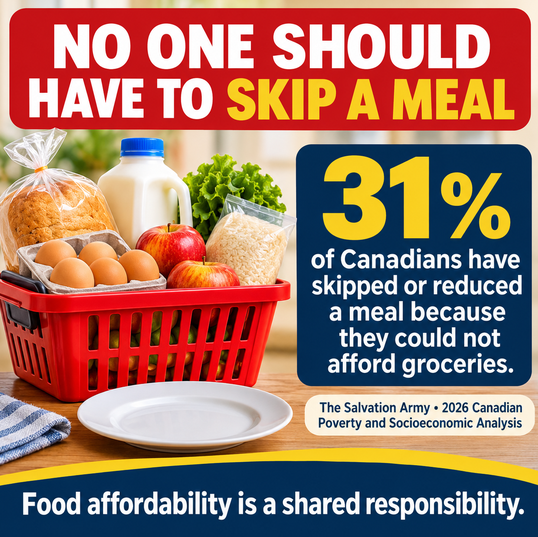
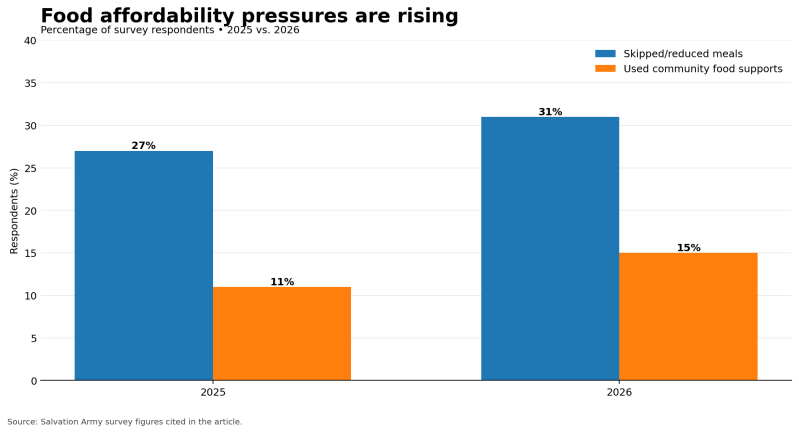
Canada is facing a serious food-affordability challenge. The Salvation Army's 2026 Canadian Poverty and Socioeconomic Analysis, released November 3, 2026, reports that 31% of Canadians have skipped or reduced the size of a meal because they could not afford groceries, up from 27% in 2025. The proportion accessing community food supports also increased, from 11% to 15%.
This is more than a grocery-price issue. It reflects the pressure that housing, transportation, utilities and other essential expenses place on household budgets.
Who is struggling the most?
The Salvation Army found that younger adults are particularly affected: 41% of Canadians aged 18–34 reported skipping or reducing meals because of grocery costs. Among respondents aged 55 and older, 55% reported difficulty managing limited financial resources, compared with 76% of younger adults.
The Salvation Army
The University of Toronto's PROOF research group, using Statistics Canada household food-insecurity data, estimated that 24% of Canadians—approximately 9.8 million people, including 2.4 million children—lived in food-insecure households in 2025. This measure includes people worrying about running out of food as well as those experiencing more severe deprivation.
PROOF
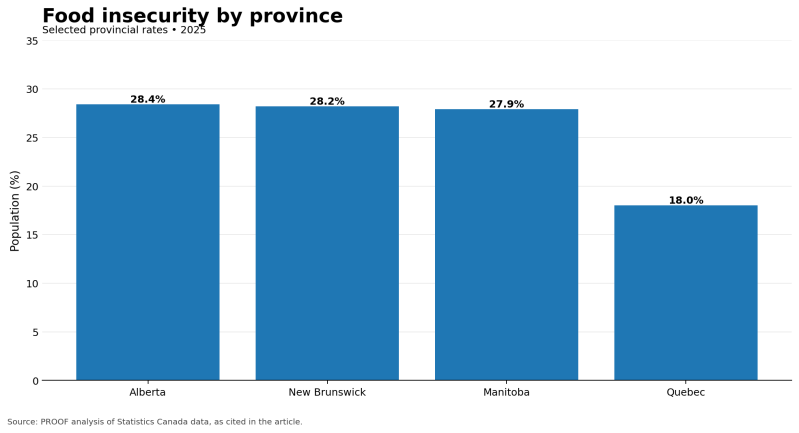
Among the provinces, the highest food-insecurity rates were:
-
Alberta: 28.4%
-
New Brunswick: 28.2%
-
Manitoba: 27.9%
Quebec had the lowest provincial rate, at 18%. Nunavut had the highest rate overall, at 56.4%.
PROOF
Ontario also faces substantial pressure. Feed Ontario's 2025 Hunger Report recorded 1,007,441 unique food-bank users and 8.71 million visits between April 2024 and March 2025. One in four visitors had a job. Source: feedontario.ca, New data on household food insecurity in 2025
What does food actually cost?
Statistics Canada's September 2026 retail-price data provides a useful benchmark for everyday grocery expenses.
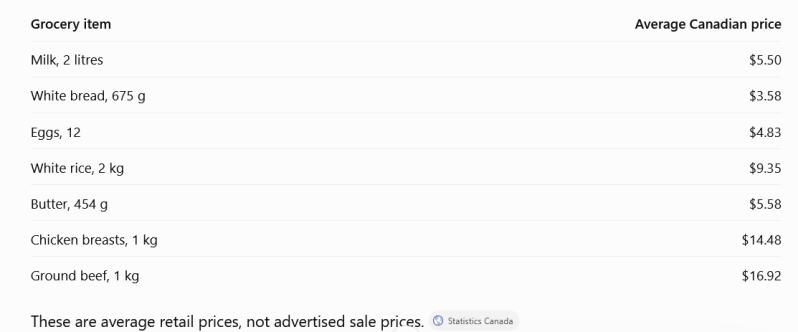
There is also a distinction between inflation slowing and groceries becoming affordable. Food Banks Canada reports that food prices have risen approximately 30% since 2021. Even when inflation falls, consumers continue paying the higher underlying prices.
Food Banks Canada
What are grocery retailers charging?
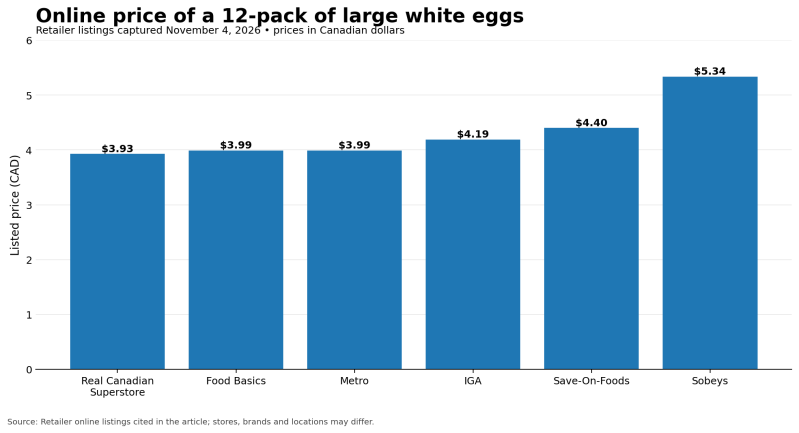
A snapshot of publicly displayed online prices for large white eggs (12-count packages) illustrates the variation between retailers.
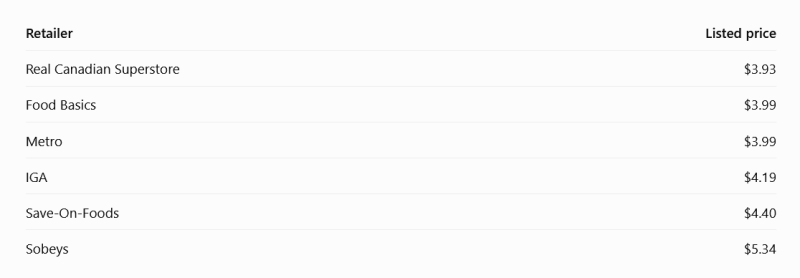
These are online listings retrieved November 4, 2026, not a controlled national price survey. Brands, store locations, promotions and product specifications can differ.
The food-bank crisis is growing
Food Banks Canada's 2026 HungerCount recorded approximately 2.35 million food-bank visits in March 2026, an 8.7% increase over the previous year and approximately 117% above 2019.
Children represented 32.5% of food-bank clients, or nearly 776,000 monthly visits. Approximately 18% of food-bank clients were employed.
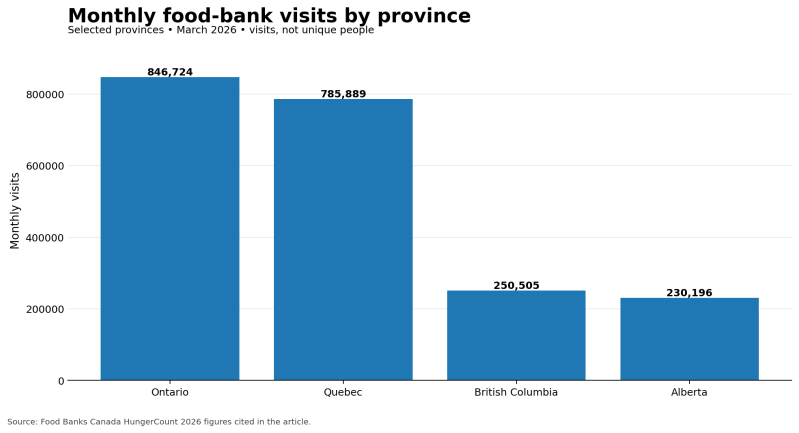
Ontario recorded 846,724 monthly visits, while Quebec recorded 785,889. These figures are visits, not unique individuals.
This demonstrates that having a job does not necessarily mean a household earns enough to afford food and housing.
How can Canada and Ontario combat food insecurity?
Food banks and charitable organizations provide essential emergency support, but they cannot replace adequate household incomes or affordable housing.
1. Strengthen household incomes
-
Modernize Employment Insurance to better support part-time, seasonal, self-employed and gig workers.
-
Increase the Canada Workers Benefit for low-income working households.
-
Review disability benefits, social assistance and income-support programs to reflect the actual cost of living.
-
Strengthen support for single-parent families and households with children.
These measures are consistent with recommendations from Food Banks Canada and PROOF.
2. Make essential groceries more affordable
Federal and provincial governments should explore targeted incentives for independent, non-franchised grocery stores that agree to provide publicly advertised discounts on essential products such as milk, bread, eggs and fresh produce.
Ontario could pilot a grocery-affordability program offering eligible independent grocers financial or property-tax incentives in exchange for measurable discounts for seniors and lower-income households. Participation should be voluntary, independently verified and publicly reported.
3. Improve food access in Ontario
Ontario should:
-
Expand school breakfast and nutritious meal programs.
-
Increase funding for food banks and community food programs.
-
Improve access to affordable fresh produce in under-served neighbourhoods.
-
Strengthen affordable housing and income supports so families do not have to sacrifice groceries to pay rent.
4. Improve accountability and transparency
Canada needs better visibility into wholesale food prices, retail markups, supply-chain costs and regional price differences. Publicly accessible grocery-price monitoring can help consumers, policymakers and businesses understand where costs are increasing and identify opportunities for savings.
Conclusion
No Canadian should have to choose between paying rent, purchasing medication and eating a nutritious meal.
The Salvation Army's findings, food-bank statistics and household food-insecurity research show that food affordability is a structural economic issue, not simply a matter of individual budgeting.
Canada needs coordinated action from governments, grocery retailers, food producers, charities and local communities. Emergency food assistance is essential today, but lasting progress requires making nutritious food affordable and ensuring households have enough income to buy it.
Data note: The Salvation Army's 2026 survey used 1,525 respondents from an online Angus Reid Forum panel. It was weighted by age, gender and region; it was not a probability sample, so a conventional margin of error cannot be calculated. Statistics Canada's retail prices are transaction-based averages, whereas the retailer examples above are advertised online listings.
MARKET NEWS & ANALYSIS
by Ananya Majumder
Canadian Food Industry • Global Market News • Food Affordability
Understanding the forces shaping Canada's food economy.
Canada Food Market Monitor provides independent, research-based coverage of Canada's food industry and international agricultural markets. We examine food prices, commodity markets, agricultural production, wholesale trade, imports, exports, food distribution, business costs and household affordability.
Our purpose is to go beyond headlines. We explain what the numbers mean, why markets are changing, who is affected and what businesses, consumers and policymakers should understand.
Whether you are a farmer, grocery retailer, restaurant owner, food manufacturer, wholesaler, distributor, consumer or elected official, our market analysis is designed to make complex food-industry developments easier to understand.
LATEST MARKET BRIEFING
Market information current to November 2, 2026
1. Canadian grocery inflation slows, but food affordability remains a challenge
Canada's grocery inflation rate slowed considerably in September 2026. Statistics Canada reported that prices for food purchased from stores increased by 1.7% year over year, compared with 2.8% in August.
This was the smallest annual increase since May 2024. However, a slower rate of inflation does not mean grocery prices have returned to earlier levels.
Statistics Canada reports that grocery prices were still 33.0% higher in September 2026 than in September 2020.
Some categories continued to experience significant price increases. Fresh or frozen beef was 8.7% more expensive year over year in September, while fresh vegetables were 2.9% lower and sugar and confectionery prices were 2.7% lower.
Why this matters
For consumers: A smaller annual increase may provide some relief, but households are still paying substantially more than they did several years ago. The accumulated increase in the price level is important when assessing household affordability.
For grocery retailers and restaurants: Lower inflation does not automatically mean lower purchasing costs. Businesses must distinguish between the rate at which prices are rising and the actual prices they pay for inventory, ingredients, transport and labour.
For policymakers: Inflation figures should be considered alongside household incomes, housing costs, food insecurity and the prices of essential food categories. A lower inflation rate alone does not demonstrate that food is affordable.
Market assessment: Canada's grocery inflation rate has moderated, but the accumulated increase in food prices remains a structural affordability concern.
Source: Statistics Canada, Consumer Price Index, September 2026, released October 19, 2026.
2. Global food commodity prices rise as weather and trade disruptions affect markets
The United Nations Food and Agriculture Organization (FAO) reported that its Food Price Index averaged 136.0 points in September 2026, an increase of 1.5% from August and 5.8% compared with September 2025.
The increase was not uniform across all food commodities.
-
Cereals: The FAO Cereal Price Index increased 5.1% from August and was 17.2% above September 2025.
-
Vegetable oils: The index increased 0.9% during September and was 18.3% higher than a year earlier.
-
Sugar: The index increased 6.1% from August amid concerns about production prospects.
-
Meat: The index declined 1.1% during September.
-
Dairy: The index was broadly stable, declining 0.1%.
The FAO identified transportation disruptions, concerns about weather conditions and constraints affecting international trade routes as factors influencing several commodity markets.
Why this matters to Canada
Canada is both a major agricultural producer and an internationally connected food market. Global price movements can influence Canadian producers, processors, exporters, importers and food manufacturers.
For example, higher international cereal quotations can affect grain marketing opportunities and the costs faced by businesses that purchase grain or grain-based ingredients. Changes in vegetable oil markets may be relevant to food processors and manufacturers.
However, international commodity prices do not translate directly or immediately into Canadian grocery prices. The effect depends on exchange rates, domestic production, contracts, inventories, processing, transportation, competition and the time required for costs to move through the supply chain.
Market assessment: Global commodity markets are showing renewed price pressure in several crop-based categories. Canadian businesses should monitor international quotations, freight conditions and supply developments rather than assume that every global increase will produce an equivalent domestic price increase.
Source: FAO, Food Price Index, September 2026, released October 2, 2026.
3. Canada's food supply: More fruit, eggs and meat available, but vegetable availability declines
Statistics Canada's latest annual food availability information, covering 2025, shows that food availability differs significantly by product.
Selected food availability statistics for 2025
-
Fresh fruit, including citrus: 77.9 kg per person, up 3.7% from 2024.
-
Fresh vegetables, excluding potatoes: 61.8 kg per person, down 3.3%.
-
Total poultry, boneless weight: 26.1 kg per person, up 3.9%.
-
Beef, boneless weight: 14.2 kg per person, up 3.2%.
-
Pork, boneless weight: 14.1 kg per person, down 0.1%.
-
Eggs: 22.5 dozen per person, up 4.8%.
Fresh vegetable availability declined for the seventh consecutive year.
Beef availability increased, primarily because imports rose by 21.7% year over year. Canadian egg production also approached one billion dozen in 2025.
What the figures tell us
Food availability is an important part of understanding the food economy, but it is not the same as food affordability.
More food being physically available does not guarantee that every household can afford it. Nor does a decline in availability automatically mean that a shortage exists in every region or retail market.
The vegetable trend deserves attention because sustained declines in per-person availability may have implications for domestic production, imports, seasonal supply and consumer choice.
For businesses, availability data can help inform sourcing and inventory decisions. For governments, it can help identify areas where production capacity, trade resilience or food access deserve further examination.
Source: Statistics Canada, Food availability and affordability in Canada, October 15, 2026. The availability figures are for 2025.
4. Grocery competition: Why the entire food supply chain matters
Food affordability is not determined by grocery stores alone.
Food moves through several stages before reaching consumers:
Agricultural production → Processing → Packaging → Transportation → Distribution → Wholesale → Retail
Each stage involves costs, business decisions and market relationships.
In June 2026, Canada's Competition Bureau announced a broader examination of competition across the food supply chain. Its work includes production and processing, transportation and distribution, and retail pricing practices.
The Bureau's September 2026 progress update also discussed its earlier grocery-market recommendations, including concerns about property controls and competition in the retail grocery sector.
The Bureau has stated that its broader examination is intended to identify where competition may not be working effectively and where improvements could support affordability and consumer choice. Its final report is expected in spring 2027.
Why this matters
For small grocery stores: Access to competitive wholesale purchasing, suitable commercial locations and reliable distribution can influence their ability to compete.
For food manufacturers: Processing, packaging, input costs and access to distribution channels can affect their ability to bring products to market.
For farmers and producers: Market access, processing capacity and buyer relationships influence their ability to sell products competitively.
For consumers: Competition can contribute to better prices and greater choice, but it is not the only factor affecting food costs.
For governments: A complete examination of affordability should consider competition and market concentration alongside transportation, production costs, trade, labour, energy, infrastructure and household purchasing power.
Market assessment: Examining the entire supply chain is important. Focusing exclusively on supermarket prices risks overlooking costs and competitive barriers that arise before food reaches the store.
Source: Competition Bureau Canada, June 16, 2026 announcement and September 3, 2026 progress update.
5. Food insecurity: The difference between food supply and food access
Canada produces and imports substantial quantities of food, yet many households continue to experience difficulty accessing enough food.
Statistics Canada's latest figures reported that approximately 9.8 million people, or 24.0% of Canadians, lived in households experiencing some form of food insecurity in 2024.
This was a reduction of just over 360,000 people compared with the previous year, but the overall proportion remains significant.
Food insecurity is not simply a question of whether food exists in the marketplace. It is also a question of whether households have sufficient financial resources to obtain an adequate and nutritious diet.
Housing expenses, employment income, debt, family circumstances and the cost of essential goods can all influence a household's ability to afford food.
Implications for public policy
Food affordability requires a broader response than monitoring grocery inflation alone.
Policymakers may need to consider:
-
Household income and purchasing power.
-
Access to affordable and nutritious food.
-
The cost and availability of fresh produce.
-
Support for food banks and community food organizations.
-
Opportunities for local food producers and independent retailers.
-
Competition and efficiency throughout the food supply chain.
-
Regional differences in food distribution and transportation costs.
Market assessment: Food security is an economic and social issue. Measuring food prices, household financial pressures and food availability together provides a more complete picture than any single indicator.
Source: Statistics Canada, Food availability and affordability in Canada, October 15, 2026. Food insecurity figures refer to 2024.
UNDERSTANDING THE FOOD ECONOMY
How food prices move from farm to table
Food prices are influenced by a combination of domestic and international conditions.
Agricultural production
Farmers face costs associated with land, seed, fertilizer, fuel, machinery, labour, financing, weather and crop yields. Changes in these factors can affect the price at which agricultural products are offered to processors and buyers.
Processing and manufacturing
Many agricultural products undergo processing before they reach consumers. Milling, slaughtering, refining, packaging, refrigeration, quality control and manufacturing add costs and value.
Transportation and distribution
Food must be moved from farms, ports, processing facilities and warehouses to retailers and commercial customers. Fuel prices, freight availability, storage capacity, labour and distance can influence distribution costs.
Wholesale markets
Wholesalers connect producers, importers, manufacturers and retailers. Their prices can vary by volume, product grade, location, contract, delivery conditions and market availability.
Retail markets
Retail prices reflect more than the cost of the original agricultural product. They can also include processing, packaging, distribution, store operations, wages, rent, financing, losses, promotions and business margins.
Important: A change in a farm-gate commodity price does not necessarily produce an equal or immediate change in the supermarket price. Different contracts, inventories, processing requirements and market conditions affect how costs move through the supply chain.
GLOBAL MARKET WATCH
Our global coverage will monitor developments that may affect Canadian food producers, businesses and consumers.
Market areas we monitor
Grains and cereals: Wheat, corn, rice and barley. Relevant to flour, bread, animal feed and food manufacturing.
Oilseeds: Canola, soybeans and palm oil. Relevant to cooking oils, processing and biofuel markets.
Pulses: Lentils, peas and chickpeas. Relevant to Canadian exports, food ingredients and global demand.
Livestock: Beef, pork and poultry. Relevant to meat supply, feed costs and processing.
Dairy: Milk, butter and cheese. Relevant to farm production and food manufacturing.
Sugar: Global production and export quotations. Relevant to food processing and consumer products.
Fertilizer: Nitrogen, phosphate and potash. Relevant to agricultural production costs.
Energy and freight: Fuel, shipping and logistics. Relevant to transportation and distribution costs.
Currency and trade: Exchange rates, tariffs and trade flows. Relevant to import costs and export competitiveness.
Our analysis will distinguish between confirmed market data, reported developments, forecasts and our own interpretation.
BUSINESS & INDUSTRY INTELLIGENCE
Food-market developments can have different implications for different types of businesses.
Farmers and agricultural producers
We follow crop production, input costs, farm-gate prices, weather conditions, export demand and agricultural policy.
Grocery retailers and independent food stores
We examine wholesale purchasing conditions, product availability, distribution costs, supplier pricing and retail competition.
Restaurants and food-service businesses
We follow ingredient prices, meat and produce markets, bulk purchasing conditions, food-service supply and operating-cost pressures.
Food manufacturers and processors
We monitor agricultural input prices, packaging, energy, transportation, international supply and processing-sector developments.
Wholesalers, distributors and importers
We cover commodity availability, supplier quotations, import conditions, freight, currency movements and trade developments.
Investors and industry professionals
We provide market context on agricultural commodities, food processing, supply-chain investment, trade and industry trends.
FOOD AFFORDABILITY & PUBLIC POLICY
Food affordability is a subject that affects every level of government and every part of the food economy.
Canada Food Market Monitor examines policy developments and economic indicators relevant to:
-
Grocery competition and market transparency.
-
Agricultural production and domestic food capacity.
-
Food imports and exports.
-
Independent grocery retailers and small food businesses.
-
Transportation and distribution infrastructure.
-
Food insecurity and access to nutritious food.
-
Food waste and supply-chain efficiency.
-
Agricultural labour, input costs and investment.
We aim to explain the economic evidence behind policy discussions, identify the trade-offs and distinguish measurable outcomes from political claims.
Our coverage is intended to inform public discussion, not to endorse a political party, government or commercial interest.
OUR MARKET ANALYSIS APPROACH
Every market analysis should answer five questions:
-
What happened? The verified event, statistic or market development.
-
Why did it happen? The known economic, supply, demand, weather, policy or trade factors.
-
Who is affected? Producers, processors, businesses, consumers or governments.
-
What could happen next? Relevant risks, opportunities and published forecasts.
-
What should be monitored? The data and developments that could confirm or change the assessment.
We distinguish actual market prices from forecasts, retail prices from wholesale prices, and farm-gate prices from international futures benchmarks.
Where information is unavailable or uncertain, we say so. We do not manufacture price figures, invent market trends or present an assumption as a confirmed fact.
DATA SOURCES & RESEARCH
Our reporting uses publicly available data and research from recognized institutions, including:
Statistics Canada
Consumer prices, agricultural statistics, food availability, food insecurity and trade data.
https://www.statcan.gc.ca/
Agriculture and Agri-Food Canada
Agricultural outlooks, commodity markets, production and trade analysis.
https://agriculture.canada.ca/
Competition Bureau Canada
Competition, grocery markets and food supply-chain analysis.
https://competition-bureau.canada.ca/
Food and Agriculture Organization of the United Nations (FAO)
International food prices, global agricultural production and food-market analysis.
https://www.fao.org/
Agricultural Market Information System (AMIS)
International monitoring of major food commodity markets.
https://www.amis-outlook.org/
Canadian Grain Commission
Canadian grain quality, deliveries, exports and grain statistics.
https://www.grainscanada.gc.ca/
Bank of Canada
Inflation, interest rates, exchange rates and economic conditions.
https://www.bankofcanada.ca/
Each published article will identify the relevant source, reporting period, publication date and any important limitations in the underlying data.
CONTRIBUTE TO CANADA'S FOOD MARKET DISCUSSION
We welcome information and perspectives from Canadian farmers, agricultural producers, grocery retailers, independent food stores, wholesalers, distributors, food manufacturers, researchers, industry associations and consumers.
Businesses and industry professionals may submit:
-
Verified commodity and wholesale price information.
-
Agricultural production and supply updates.
-
Supplier and distribution developments.
-
Food import and export information.
-
Industry research and market reports.
-
Evidence-based commentary on food affordability.
Submissions may be reviewed and verified before publication. Commercially confidential information will not be published without appropriate permission.
Contact:info@canfoodx.ca
CANADA FOOD MARKET MONITOR
Tracking Food Prices. Understanding Markets. Supporting Affordability.
Independent market information and analysis to support informed decisions across Canada's food economy.