

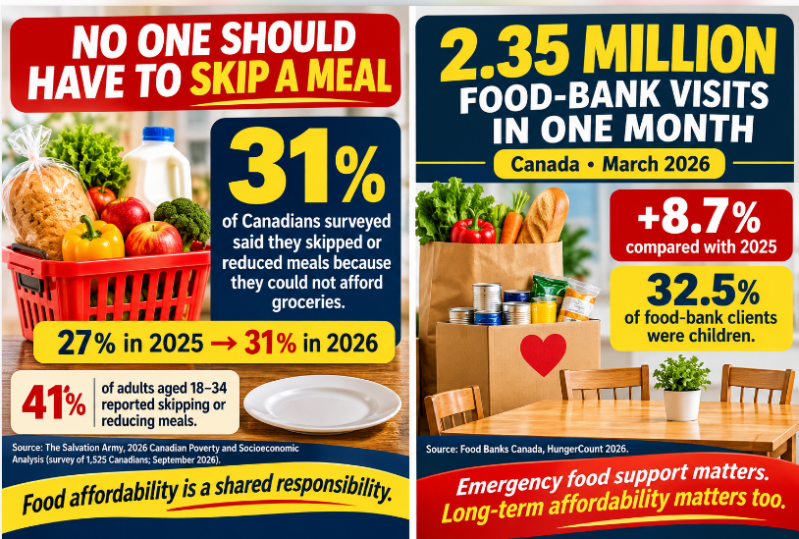
Food insecurity is becoming a serious challenge for Canadian households. According to the Salvation Army's 2026 Canadian Poverty and Socioeconomic Analysis, 31% of Canadians have skipped or reduced meals because they could not afford groceries, up from 27% in 2025. Among young adults aged 18–34, the figure reaches 41%.
The pressure is also visible in food-bank demand. Food Banks Canada's 2026 HungerCount recorded approximately 2.35 million food-bank visits in a single month, an increase of 8.7% over the previous year. Children accounted for 32.5% of clients.
Research by the University of Toronto's PROOF project estimates that 9.8 million Canadians, including 2.4 million children, lived in food-insecure households in 2025.
What can we do?
-
Expand income support for low-income working families and seniors.
-
Strengthen school meal and community food programs.
-
Encourage grocery retailers to offer affordable essential-food baskets.
-
Support independent grocers through incentives tied to verified discounts.
-
Improve transparency around wholesale and retail food prices.
Food banks provide vital emergency assistance, but long-term solutions must address inadequate incomes, housing costs and food affordability.
No Canadian should have to choose between paying rent and eating a proper meal.
Source:
-
The Salvation Army – 2026 Canadian Poverty and Socioeconomic Analysis (November 3, 2026).
One accuracy note: the Salvation Army's 31% figure comes from its survey of 1,525 Canadians, not a census of the entire population.