

Ananya Majumder, CanFoodX | Canadian Food Market Intelligence
Butter is one of Canada's most familiar grocery staples. But behind the price of a 454 g package lies a much larger economic story involving dairy supply management, domestic production, international imports, processing, distribution and retail pricing.
For consumers, understanding these factors can help with grocery budgeting.
For bakeries, restaurants, food manufacturers, wholesalers and distributors, understanding the wholesale market can influence procurement decisions and operating costs.
Here is what the latest available Canadian data tells us.
1. What does butter cost in Canada?
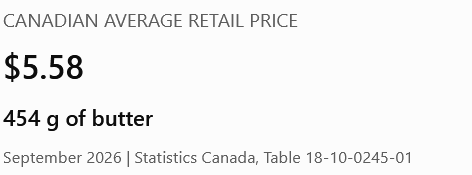
Statistics Canada's September 2026 release, published November 4, reports a national average of $5.58 for 454 g of butter. The data is based on actual retailer transaction information, rather than a survey of a handful of shelf prices.
What about Ontario?
Statistics Canada provides provincial data, including Ontario, in the same table. I have not included a specific Ontario provincial average here because I could not independently extract and verify the September Ontario observation. It would be misleading to substitute a retailer's advertised price for a provincial average.
The following supplier comparisons provide a separate Ontario wholesale perspective.
2. What are businesses paying for wholesale butter?
This is where the comparison becomes particularly interesting.
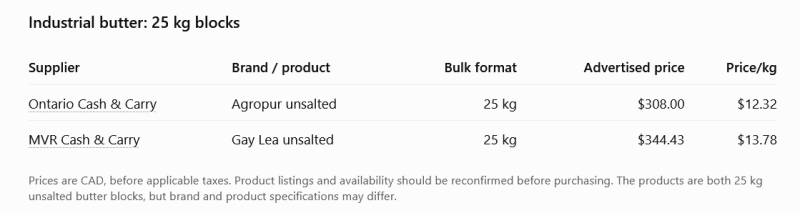
The following are publicly advertised supplier prices, not negotiated contract prices or a national wholesale index.
Industrial butter: 25 kg blocks
Smaller foodservice cases: a separate comparison
A1 Cash & Carry advertises Gay Lea unsalted butter in 20 × 454 g cases for $137.29.
That is 9.08 kg of butter in total, or approximately $15.12/kg. This is a smaller packaged format, so it should not be directly compared with a 25 kg industrial block as if they were identical products.
A1 Cash and Carry
What does this tell us?
For the two advertised 25 kg listings:
Advertised CAD price per kilogram; 25 kg unsalted blocks. Not a national wholesale average.
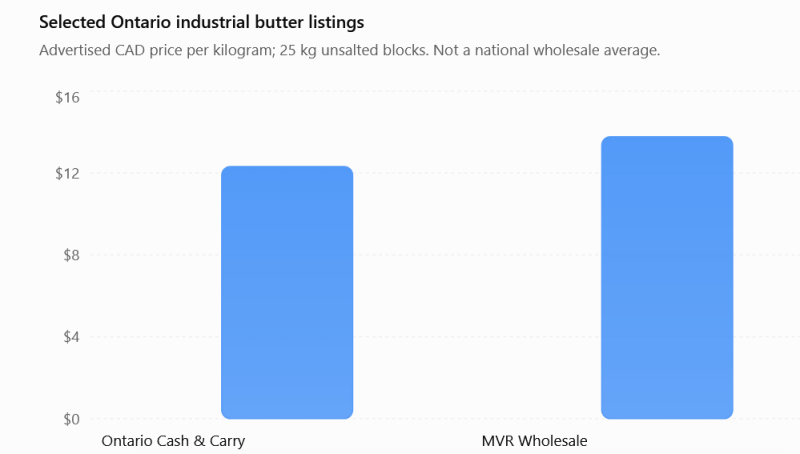
The difference is $1.46 per kilogram, or $36.50 on a 25 kg purchase.
This illustrates why businesses should compare supplier quotations before placing bulk orders.
It does not establish that one supplier is consistently cheaper across Canada. Freight, account pricing, availability, product specifications and purchase volumes can change the final cost.
3. Canada's butter production: are we producing enough?
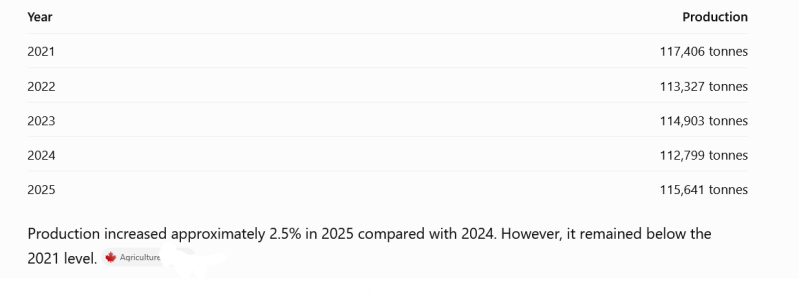
Canada's domestic butter production has fluctuated over the past five years.
Annual production in metric tonnes. Source: Agriculture and Agri-Food Canada.
Why does this matter?
Butter production depends on the availability of milk fat, which is also required for other dairy products.
The allocation of milk components between butter, cheese, cream and other dairy products influences the quantities available for different markets.
For manufacturers, this is important because the cost and availability of butterfat can affect production planning and ingredient procurement.
4. Canada's butter imports are increasing
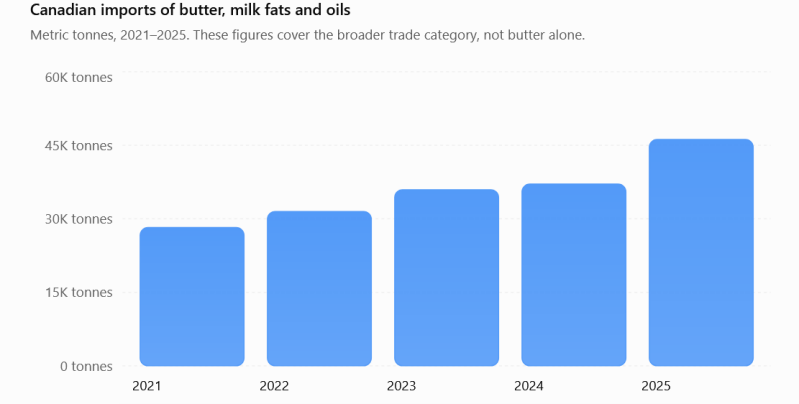
One of the most significant developments is the growth in Canadian imports of butter, milk fats and oils derived from milk.

According to Agriculture and Agri-Food Canada:
-
Imports increased from 28,229 tonnes in 2021 to 46,189 tonnes in 2025.
-
The United States accounted for approximately 75% of import volume in 2025.
-
New Zealand accounted for approximately 23%.
This is a notable development for Canadian food manufacturers and ingredient buyers.
Agriculture and Agri-Food Canada
An important distinction: These figures cover butter, fats and oils derived from milk. They should not be described as imports of conventional retail butter alone.
5. Are Canadians consuming more butter?
The data suggests that butter consumption has recovered from its 2024 decline.
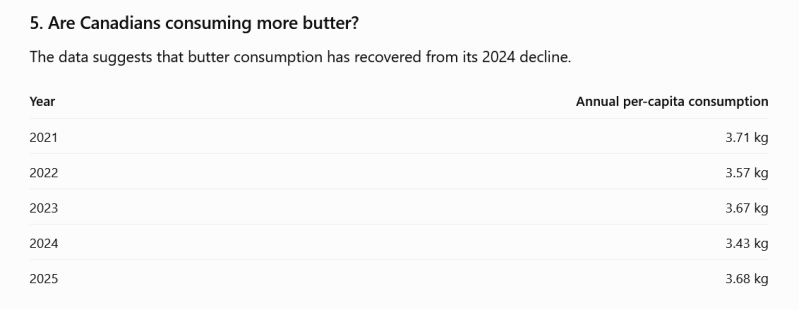
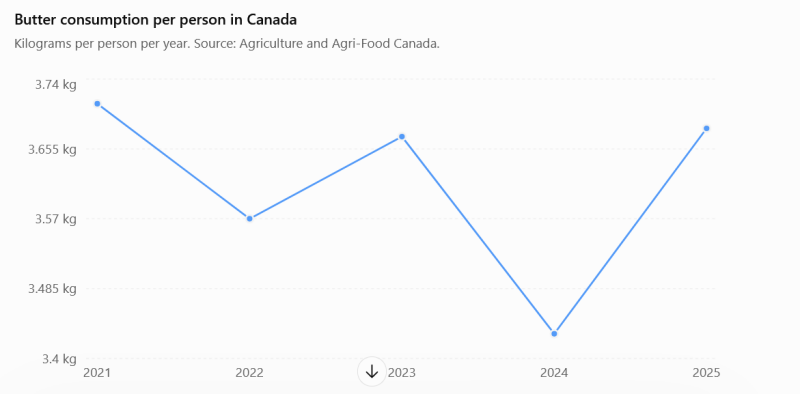
In 2025, consumption reached 3.68 kg per person, close to the 2021 level of 3.71 kg.
Agriculture and Agri-Food Canada
This is relevant for retailers, food manufacturers and distributors because changes in consumer demand influence purchasing and inventory decisions.
6. What does Canada's dairy pricing system mean for butter?
Canada operates under a dairy supply-management system.
This system involves production controls, farm-level milk pricing and import controls. It is designed to balance domestic supply and demand while providing a more predictable framework for dairy producers.
The Canadian Dairy Commission also operates a Domestic Seasonality Program, buying and storing butter when domestic milk production is high and releasing it when demand rises relative to supply.
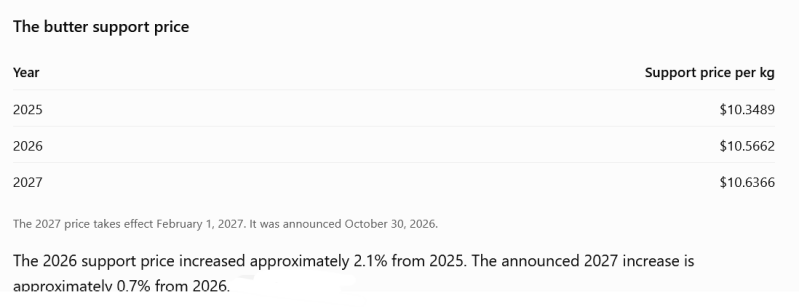
What is the support price?
It is the price at which the Canadian Dairy Commission buys and sells butter under its programs. It is not the price that supermarkets or every wholesaler must charge.
This distinction matters when comparing government dairy benchmarks with commercial wholesale quotations.
7. What should Canadian consumers know before buying butter?
There are several practical ways to make more informed purchasing decisions.
-
Compare the price per kilogram. A larger package is not automatically cheaper.
-
Watch promotional pricing. Compare sale prices with regular prices and check any purchase limits.
-
Compare brands and package sizes. Different brands and formats may have substantially different unit prices.
-
Look at salted versus unsalted butter. Buy according to your cooking and baking requirements.
-
Consider freezing butter. It can help households take advantage of promotions without using the product immediately.
-
Compare butter with substitutes carefully. Margarine and butter blends are not the same product, and their ingredients and cooking properties differ.
8. What should food businesses be watching?
For commercial buyers, the retail price is only one part of the story.
The following factors deserve regular attention:
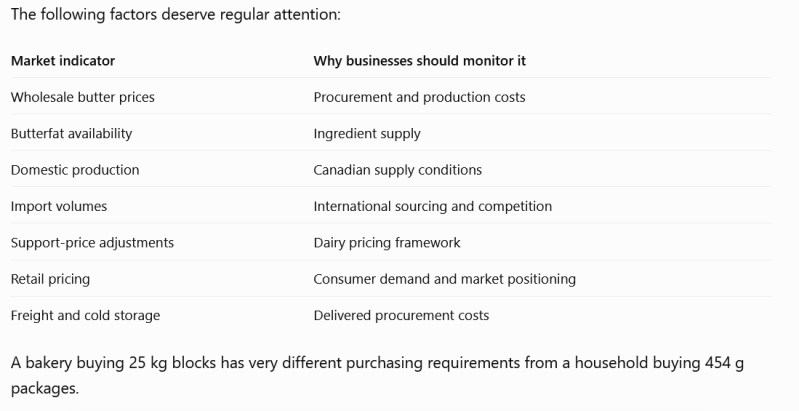
A food manufacturer may also need to compare butter solids, butteroil, salted butter and unsalted butter. Those products cannot simply be treated as interchangeable.
9. The bigger picture: what do these numbers tell us?
There are four important takeaways from this research.
1. Butter affordability remains an issue. Agriculture and Agri-Food Canada reports that the butter Consumer Price Index increased approximately 25% between 2021 and 2025. This was the same increase reported for all food purchased in stores over that period.
Agriculture and Agri-Food Canada
2. Canada is producing substantial quantities of butter, but imports are growing. This is an important development for the domestic dairy and food-processing industries.
3. Wholesale pricing varies. The two Ontario 25 kg supplier listings show a difference of $1.46 per kilogram. Commercial buyers should compare specifications and delivered prices.
4. Market transparency matters. Consumers need understandable retail price information, while businesses need supplier quotations, commodity trends and supply-chain data.
The evidence does not establish that imports are causing higher retail prices, or that Canada is experiencing a butter shortage. Those conclusions would require additional market analysis.
10. What CanFoodX is tracking
CANFOODX
Making Canada's Food Markets More Transparent.
CanFoodX is developing a Canadian food-market information and business network focused on:
-
Retail food-price comparisons
-
Wholesale supplier pricing
-
Agricultural production and imports
-
Commodity price movements
-
Food manufacturers and processors
-
Suppliers, distributors and retailers
Our objective: Make food-market information more accessible to the businesses and consumers who depend on it.
canfoodx.ca